
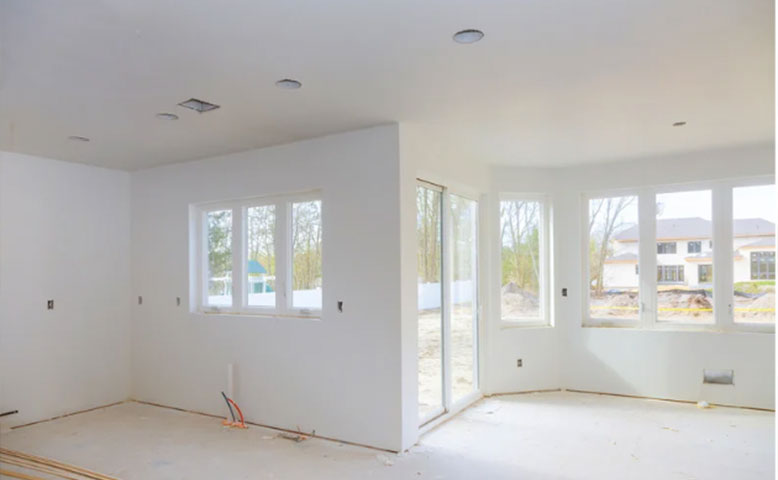
Drywall looks simple, but small steps decide if your walls stay smooth or crack. Good planning means fewer seams, fewer fasteners, and less sanding later. This article breaks down drywall installation into smart moves you can follow today. You’ll see what size board to pick, how far apart to place screws, and how to finish seams so they stay flat.
We’ll use easy words, short lists, and clear stats. Even if you are new to tools, you can follow along and avoid common slips like over-driving screws or lining up seams at door corners. Read on, mark your lines, and build walls that look clean and last.
Plan Layout And Choose The Correct Drywall
Start with a simple sketch. Show doors, windows, and studs. Aim to land seams on studs and keep them away from the corners of openings by at least 6 inches. Plan so you use the fewest seams possible.
Quick facts (board types and uses):
- 1/2-inch regular: standard for most walls.
- 5/8-inch Type X: stiffer for ceilings; helps meet a 1-hour fire rating when used in tested assemblies.
- Moisture-resistant (“green” or “purple”): baths, laundry, and splash zones.
- Cement board: behind tile in wet areas like showers.
- 3/8-inch: bends for gentle curves.
Size and weight:
- 4×8 ft is common; 4×12 ft cuts seams on long walls.
- A 1/2-inch 4×8 sheet weighs about 50–60 lb; a 5/8-inch 4×8 sheet is about 70–75 lb.
Stud spacing goal:
- Most homes use 16 inches on center (OC); some ceilings use 12 inches OC for more support.
Tip: Stack boards horizontally on walls. This lowers the number of seams and helps hide waves in studs.
Cut Panels Safely With Clean, Square Edges
A clean cut makes a clean seam. Use a sharp utility knife and a long straightedge. Score the face paper, snap the board, then cut the back paper. Keep your other hand away from the blade path.
Tools you need:
- Utility knife with fresh blades
- T-square or 4-ft level as a straightedge
- Keyhole (jab) saw for outlets
- Rasp to smooth rough edges
Safe cutting steps:
- Measure and mark both ends of the sheet.
- Connect marks with a straight line.
- Score once with firm, even pressure.
- Lift and snap the board along the score.
- Cut the back paper and rasp the edge.
Openings: Trace the box outline for switches and outlets. Drill a starter hole or jab the saw in the center, then cut to your lines. Keep holes snug so plates cover them without gaps.
Dust note: Score, snap, and rasp make far less dust than power-saw cutting.
Fasten Boards With Proper Spacing And Depth
Good fastening stops nail pops and sagging. Screws hold better than nails and make fewer surface bumps.
Screw spacing targets:
- Walls: every 16 inches along studs
- Ceilings: every 12 inches along joists
- Keep screws 3/8–1/2 inch from edges so paper does not tear.
Depth check:
Drive screws just below the surface to make a small dimple, but do not break the paper. Paper is the skin that gives the panel its strength. If you break it, add a new screw.
Fastener types:
- Coarse-thread for wood studs
- Fine-thread for metal studs
- Bugle-head screws reduce tearing of the face paper
Adhesive help: A bead of construction adhesive on studs plus screws can cut fastener count and reduce pops. Still use screws; adhesive alone is not enough.
Common mistakes to avoid:
- Over-driving screws (weakens hold)
- Missing studs (use a stud finder and a pencil line)
- Using nails near edges (paper tears easily)
Stagger Joints And Avoid Fragile Butt Seams
Seam layout matters. Long factory edges have a tapered recess that accepts tape and mud. Butt edges are flat; if you line many of them, you’ll get a hump.
Layout rules that save sanding:
- Stagger vertical joints so they don’t line up in one column.
- Keep butt joints away from door and window corners by 6 inches or more.
- If you must use butt joints, place them over a backer board or use a butt-board to recess the seam slightly.
Why staggering helps:
Staggered seams spread stress and reduce crack lines. It also lets you feather compound wider without building a ridge across the wall.
Factory edge vs. butt edge:
- Factory edge (tapered): tape sits lower; easier to hide with an 8–10 inch final feather.
- Butt edge (flat): needs a wider feather, often 12–14 inches, to fade the hump.
Ceilings: Run the long side across the joists. This gives more support and fewer seams to finish overhead.
Tape Corners And Seams For Lasting Strength
Tape locks the joint and stops cracks. You can choose between paper tape and fiberglass mesh.
Pick the right tape:
- Paper tape: strong, best for inside corners; crease it for a sharp fold.
- Fiberglass mesh: fast for flat seams; must be used with setting-type compound to avoid bubbles.
Three coat system (simple view):
- Tape coat: Embed tape in a thin bed of compound.
- Fill coat: Cover the tape, fill low spots, and screw dimples.
- Finish coat: Feather edges wide and smooth.
Inside corners: Use a corner trowel or two knives. Apply compound to both sides, press the folded paper tape, then smooth each side. Keep one side tight while you pass the other, so you don’t pull the tape loose.
Outside corners: Use metal, vinyl, or paper-faced bead. Nail or crimp bead straight, then cover with two to three coats until the profile fades.
Apply Compound In Thin, Controlled Finishing Coats
Thin coats dry faster and shrink less. Thick coats crack, sag, and take forever.
Compound choices:
- All-purpose (pre-mix): easy to sand; good for tape and finish.
- Topping (pre-mix): smooth and light; great for final coats.
- Setting-type (“hot mud”): chemical set in 5/20/45/90 minutes; ideal for the tape coat and quick fills.
Application pointers:
- Keep the knife clean; a tiny chunk makes a long scratch.
- Feather each side wider than the last: 4–6 in., then 8–10 in., then 12 in.
- Fill screw dimples in passes; don’t try to cover in one blob.
Sanding facts:
- Use 120–150 grit for the first sand, 180–220 grit to finish.
- Shine a raking light along the wall to spot ridges.
- Wear a dust mask and use a sanding pole or sanding sponge.
Pro tip: If time is short, use a setting-type for the first two coats, then a light topping for the last coat to save sanding.
Prime Correctly And Control Dust Before Painting
Primer shows flaws and seals the paper and compound so the paint looks even.
Before primer:
- Vacuum walls with a brush attachment.
- Wipe with a slightly damp microfiber cloth to pick up fine dust.
- Fill any pinholes you see under the work light.
Primer basics:
- Use a PVA drywall primer for new drywall.
- Roll one full coat; let it dry; spot fix dents; then touch up primer on repairs.
- Your finish paint sticks better to primed walls and needs fewer coats.
Dust control steps that help a lot:
- Hang plastic at doorways to make a simple airlock.
- Use a shop vacuum while sanding (vac-ready sanders exist).
- Keep a clean path to the exit so dust does not spread through the home.
Small sound upgrade (easy win):
- Use acoustic caulk at the top and bottom plates and around boxes.
- Choose a 5/8-inch board on shared walls to cut noise.
Conclusion
Good drywall installation is a chain of small wins: smart layout, clean cuts, tight fastening, careful taping, thin coats, and tidy priming. Follow the numbers in this guide, and your walls will stay smooth, paint will roll on better, and repairs will be rare. If you want a crew that follows these steps every day, Quality Quest Contractor offers drywall installation services for homes and small businesses. We plan the layout, protect your space, and deliver a clean, even finish you’ll be happy to paint. Ready to make your project simple? Call Quality Quest Contractor for friendly, reliable drywall help.